
 Ivan Sichen
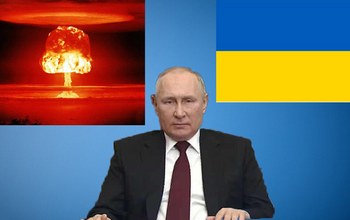
At the end of February 2022, three days after the start of the war against Ukraine, the President of the Russian Federation ordered the Russian deterrence forces – in fact the country’s nuclear forces – to put in a “special regime of combat duty”. According to Putin, who was already beginning to understand the failure of his plans for Ukraine, the reason for the decision was “the senior NATO officials’ aggressive statements” and strengthening of anti-Russian sanctions by Western countries.
On the eve of the NATO summit in Brussels on 24 March, 2022, the possibility of using nuclear weapons against Russian opponents was confirmed by the Kremlin’s spokesman D. Peskov. He referred to the provisions of Russia’s conceptual documents in the military sphere, which allow such actions. On the same day, Russia’s Deputy Representative to the United Nations, D. Polyansky, threatened with Moscow’s readiness to launch nuclear strikes on NATO countries.
And now the right question arises: what will the Putin regime see as a threat to Russia’s statehood or a provocation by NATO? Will this include: a critical aggravation of the Russian economy as a result of Western sanctions; Russia’s defeat in the war with Ukraine or NATO, if Moscow dares; liberation of the occupied territories of the Donbas and annexed Crimea by the Ukrainian army? Other topical issues also need to be addressed, including: what kind of nuclear weapons can Russia use and what carriers does it have for this? Let’s try to understand this.
According to the National Security Strategy and the Military Doctrine of the Russian Federation, Moscow can launch nuclear strikes on its adversaries (non-nuclear countries included) in response to their use of nuclear and other weapons of mass destruction against Russia or the threat of losing its statehood. At this, none of the mentioned conditions is specified, which allows the Kremlin to interpret them arbitrarily.
That is, each of the circumstances mentioned in the introduction to the article may be the reason for Moscow to start a limited or full-scale nuclear war against Ukraine and the United States/NATO in Europe. First of all, this applies to Ukraine, which does not have nuclear weapons and cannot give an adequate response to Russia. As for the relevant reason, it can be provoked by Moscow by accusing Ukraine of chemical and biological attacks on the Russian Federation. Especially since such accusation are already being raised by Russia.
Unlike Ukraine, our Western partners have something to response Russia with. Today, the United States (both in its territory and in Europe), the United Kingdom and France have nuclear weapons, which is a powerful deterrent to Russia. However, given the absolute inadequacy of the Kremlin leader, he may also dare to wage nuclear war against the United States and NATO. As Putin once said, “what for do we need a world without Russia”.
And it’s not just words. Even in the most difficult times for the Russian Federation due to the economic crisis in the country in the 1990s, Moscow had been making every effort to maintain and improve its strategic nuclear capabilities. And since 2007, following the Kremlin’s move to confront the West, such efforts have become much larger.
At the same time, the restoration of the tactical nuclear component of Russia’s armed forces was launched, which was given a special role in the implementation of Moscow’s geopolitical and military plans. To begin with, the Russian leadership was of the opinion that the use of strategic nuclear forces would inevitably lead to a full-scale nuclear war, while tactical nuclear strikes on enemy military targets would have only local consequences and leave a chance of victory.
In view of the above, the tactical nuclear weapons (TNW) of the Russian Federation need special attention. Based on the data of open sources concerning the TNW of Russia, it has the following main tasks:
- at the strategic level – neutralizing the US/NATO and China’s superiority over Russia in general forces; creating counterbalances to the tactical nuclear forces of other countries that have the ability to strike on the territory of Russia (primarily the United States, the United Kingdom, France and China); providing an adequate response to the deployment of the US/NATO missile defense system in Europe; intimidation and pressure on other countries whose policies are not in Russia’s interests;
- at the operational and tactical level – equivalent strikes in case if the enemy uses tactical nuclear weapons against Russia or high-precision long-range conventional weapons; support of troops on the battlefield during tactical or strategic offensive and defensive operations (including destruction of fortified areas, air and missile bases, warehouses, bridges, crossings and other enemy infrastructure, as well as troops and reserves).
As part of the implementation of these plans, Russia has today revived a full-fledged set of forces and inventory that allow the use of tactical nuclear weapons. Thus, the Russian armed forces have 3,000 to 5,000 tactical nuclear warheads left over from the Soviet Union after the reduction and reorganization of its nuclear forces. Among them: about 800 aircraft bomb warheads; about 500 warheads for cruise missiles, torpedoes and depth charges of surface warships and submarines; up to 600 warheads for anti-aircraft missiles; more than 1 thousand – for operational and tactical missiles and artillery systems of the ground forces.
TNW delivery systems in the Russian armed forces include both new missile and air-based systems that have been developed and adopted over the past 10–15 years, as well as old systems left over from the USSR. The main ones are:
- Iskander-M operational and tactical missile systems, as well as 152-mm self-propelled howitzers 2S19 “Msta-S” and towed howitzers 2A65 “Msta-B” from the missile and artillery brigades of the army subordination;
- self-propelled 240-mm mortars 2S4 “Tulpan” and 203-mm self-propelled guns 2S7M “Malka”, which are in the service of high-power brigades (heavy artillery brigades) of district and army subordination;
- Su-34 and Su-24M front-line bombers, as well as S-300 and S-400 anti-aircraft missile systems from the air force and air defense armies of the Russian Aerospace Forces, which are operatively subordinated to each of the military districts and the Northern Fleet of the Russian Navy;
- Tu-142, IL-38 and Be-12 naval aircrafts, which mainly support the actions of Russia’s Northern and Pacific Fleets; Be-12 aircrafts are also in service of the Black Sea and Baltic Fleets;
- surface warships equipped with P-1000 “Vulkan” and “Kalibr” missile systems (cruise missiles), as well as submarines equipped with P-700 “Granit”, P-800 “Onyks” and “Kalibr” missile systems (cruise missiles).
|
Note: The USSR armed forces had about 22,000 tactical nuclear warheads. According to agreements between the USSR/Russia and the United States, most of them were liquidated in the 1990s. In particular, all obsolete nuclear munitions, nuclear mines, more than 50 % of tactical nuclear munitions of the Navy, Air Force, Air and Missile Defense, as well as some high-power artillery and operational-tactical missiles of the ground forces were dismantled and disposed of. Most of the forces and units armed with TNW were disbanded, and delivery systems were sent to the storage bases. At this, in accordance with the Treaty on the Elimination of Intermediate-Range and Shorter-Range Missiles (1987), this class of TNW carriers was completely destroyed. However, unlike the Intermediate-Range Nuclear Forces Treaty the US-Russia/USSR agreement on tactical nuclear weapons was informal and not enshrined in official international treaties. None of the above-mentioned commitments or agreements provided or provides for the exchange of information on the quantitative composition and development of new types of TNW. No geographical restrictions on its location have been determined. Despite reducing its tactical nuclear capabilities, Russia retained every opportunity to use it. Thus, TNW carriers remained in the Russian armed forces, including large-caliber artillery systems, operational-tactical ballistic missiles, medium-range and short-range cruise missiles, as well as front-line and long-range bombers. |
In addition, operational and combat training measures were intensified to test the use of tactical nuclear weapons. Such events are held both independently and against a single operational background with exercises of other types of Russian armed forces, including within the framework of strategic command and post exercises “West”, “Caucasus”, “East” and “Center”.
As a rule, during such exercises the following tasks are practiced: deploying missile and artillery units to training grounds; launching tactical and strategic aircrafts with simulators of various nuclear warheads; deploying in position areas of warships and submarines with nuclear missile systems; practicing of artillery fire, as well as of conditional launches of surface-to-air, air- and sea-based missiles with simulated tactical nuclear strikes.
Using tactical nuclear weapons in armed conflicts with nuclear adversaries is seen by Moscow as a last resort in a critical situation, as it is likely to provoke retaliatory nuclear strikes. The consequence of this situation may be the emergence of a limited, and then – a full-scale nuclear war.
However, given the unpredictability, irresponsibility and brutal inhuman nature of Putin’s regime, he can raise the stakes to the highest possible level in the hope of survival. Therefore, Russia’s actions to restore its tactical nuclear capabilities reduce the threshold for its use of TNW in wars against other countries, including Ukraine, which is at the forefront of Moscow’s geopolitical interests and aggression. At this, the probability of World War III is growing.


